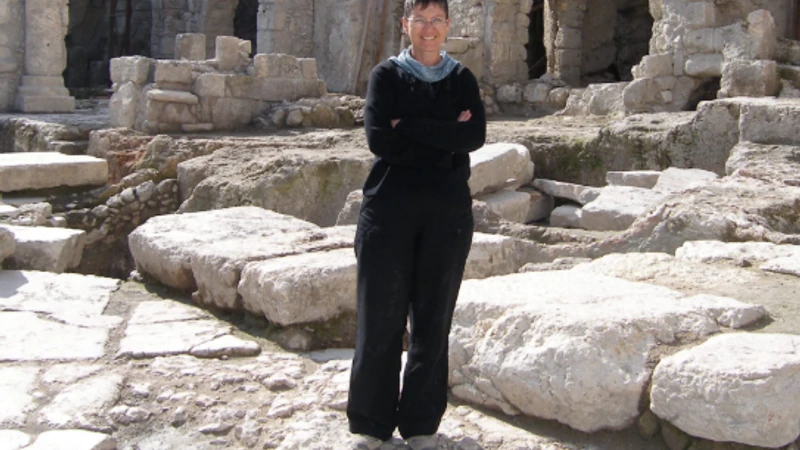
When Esther Looks Like a Woman Who Uncovers the Truth
Esther did not lead an army.
She did not shout in the streets.
She revealed what had been hidden, at the moment it mattered most.
Sometimes Esther looks like a woman with a trowel, patience, and an unshakable commitment to truth.
This week, that woman is Dr. Shlomit Weksler-Bdolah, one of the Israeli archaeologists behind the reopening of Jerusalem’s Pilgrim’s Path, a 2,000-year-old road connecting the Pool of Siloam to the Western Wall.
After two decades of excavation, the ancient road has reopened to the public for the first time since the Roman destruction of Jerusalem in 70 CE.
Not as a symbol.
Not as a theory.
But as stone beneath your feet.
A Road Walked by the Faithful
During the Second Temple period, Jewish pilgrims ascended this road three times a year to worship in Jerusalem, fulfilling the biblical command to appear before the Lord.
The road was buried for nearly two millennia, sealed beneath layers of rubble and history. Roman conquest erased it from view, but not from memory.
Dr. Weksler-Bdolah and her team worked patiently, often under political pressure and international scrutiny, to excavate the path stone by stone. Their work confirmed what Scripture, tradition, and Jewish memory have always maintained.
The Jewish people did not arrive yesterday.
They have always been here.
When History Becomes Evidence
In an age when Israel’s legitimacy is debated in lecture halls and headlines, archaeology speaks without rhetoric.
A road does not argue.
It does not posture.
It simply exists.
Coins, drainage systems, stonework, and construction methods all date unmistakably to the Second Temple period. This was not a coincidence of history. It was continuity.
Dr. Weksler-Bdolah has consistently emphasized that archaeology is not about politics. It is about truth, context, and preservation.
That stance itself requires courage.
The Quiet Courage of Stewardship
Esther’s courage was not loud.
It was deliberate.
For years, Dr. Weksler-Bdolah faced criticism from those who preferred Jerusalem remain abstract or contested rather than concrete and Jewish.
Yet she continued.
She allowed the stones to speak.
She protected the integrity of the excavation, refusing to rush conclusions or sensationalize findings. Her leadership reflects a different kind of bravery, one rooted in stewardship and restraint.
The result is a living testimony that bridges Scripture, history, and modern Israel.
For Such a Time as This
The reopening of the Pilgrim’s Path in 2026 is not accidental.
It arrives at a moment when Jewish connection to Jerusalem is challenged globally, when ancient truths are treated as negotiable, and when Christians who love Israel are asking how to stand with clarity and conviction.
Esther once revealed a hidden decree that threatened her people.
Dr. Weksler-Bdolah helped reveal a buried truth that strengthens them.
Sometimes Esther looks like a queen.
Sometimes she looks like an archaeologist.
And sometimes she simply lets the stones speak.


