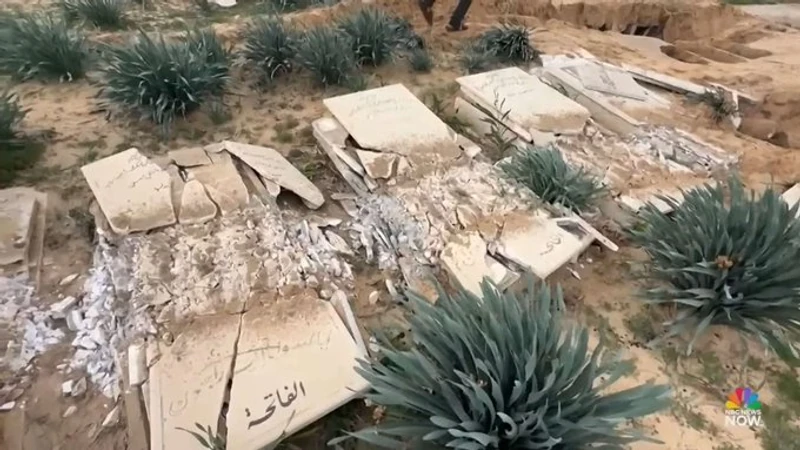
The recovery of the body of Ran Gvili, the last Israeli hostage held in Gaza, should have been a moment of solemn closure. A life stolen. A family finally able to grieve. Instead, it revealed something far darker: his body had been buried in a Muslim cemetery.
This detail has been widely skirted over. Yet it matters deeply.
The decision to bury an Israeli hostage in a Muslim cemetery was not an accident of war, but a deliberate act by Hamas.. It follows a long and disturbing pattern of exploiting Muslim holy sites for military and propaganda purposes.
A Desecration Named by Palestinian Voices
What makes this story impossible to dismiss is that Palestinian voices themselves have spoken out.
Palestinian analyst Hamza Howidy described the burial as a desecration, saying that hiding Gvili’s body in a cemetery showed “to what level these militias went: instrumentalizing death itself for political and military ends.”
Another Palestinian analyst, Ahmed Fouad Alkhatib, echoed this condemnation, noting that burying non-Muslims in Muslim cemeteries violates religious law and long-standing tradition. He described the act as a cynical propaganda ploy, one designed to ensure that when Israeli forces searched for their kidnapped citizens, they could later be accused of desecrating sacred ground.
These are not Israeli officials. These are Palestinians naming a moral boundary that was knowingly crossed.
Turning Holy Ground Into a Battlefield
News reports and watch groups document a long history of Hamas and Islamic Jihad abusing Muslim holy sites for terror activity. Mosques, cemeteries, schools, and hospitals have repeatedly been used to store weapons, house command centers, conceal tunnel networks, and launch attacks.
The burial of Ran Gvili in a cemetery fits this same pattern. Place hostages among the dead. Force Israeli forces to search there. Then weaponize the images of destruction for a propaganda campaign against Israel.
Multiple international media outlets fell into this trap, publishing stories focused on damaged graveyards while ignoring the reason Israeli forces were there at all.
When holy spaces are turned into instruments of war, the desecration begins long before a shovel ever touches the ground.
The Bitter Irony No One Wants to Confront
The bitter irony is this:
The destruction and desecration of Gaza cemeteries that the world condemns only happened because Hamas and Islamic Jihad deliberately turned those cemeteries into hiding places for Israeli hostages.
Put plainly:
Hamas and Islamic Jihad violated their own religious law by burying non-Muslims in Muslim cemeteries.
They knew Israel would search cemeteries to recover kidnapped citizens.
They anticipated that graves would be disturbed as a result.
And they counted on that disturbance to accuse Israel of desecration and fuel global outrage.
The irony is bitter because:
What should have been a place of rest for the dead was intentionally transformed into a battlefield, and then the very damage caused by that decision was used as propaganda against Israel.
Even more stark:
The last Israeli hostage was recovered from a Palestinian cemetery, not because Israel disrespects the dead, but because terror groups hid him among the dead.
Palestinian civilians and their loved ones’ graves were harmed not as a first act, but as a consequence of Hamas’s choice to weaponize sacred ground.
The world grieves the destruction of cemeteries, yet refuses to confront who placed the dead there as part of a military strategy.
That is the bitter irony no one wants to name.
This is not a conflict between faiths. It is a moral indictment of extremist groups that show contempt for life, for religious law, and for the sanctity of the dead.
Finally Home
And yet, amid the sorrow, there is a quiet truth that must not be lost.
Ran Gvili is finally home.
His body has been recovered. His family can now mourn without uncertainty. His name will no longer be hidden or used as a bargaining chip beneath a grave meant to serve a lie.
For Christian Women for Israel, this matters deeply. We believe every life is known by God, every tear is seen.
A Prayer for Ran Gvili and His Family
God of justice and mercy,
We lift up the family of Ran Gvili.
After long months of waiting, fearing, and hoping, may they now know peace in the knowledge that he is home and at rest.
Comfort those who loved him. Surround them with strength in their grief. Let his memory be honored, not exploited, and let his soul rest in eternal peace.
Heal what has been violated. Guard what is sacred. And hasten the day when the dead are no longer used as weapons, and peace is no longer postponed.
Amen.


