When the Killing Didn’t End and Why Truth Still Has Enemies
There are stories from the Holocaust era that end with liberation—and then there are stories that refuse to end. Among Neighbors is one of those stories.
After the war is not the same as after the danger.
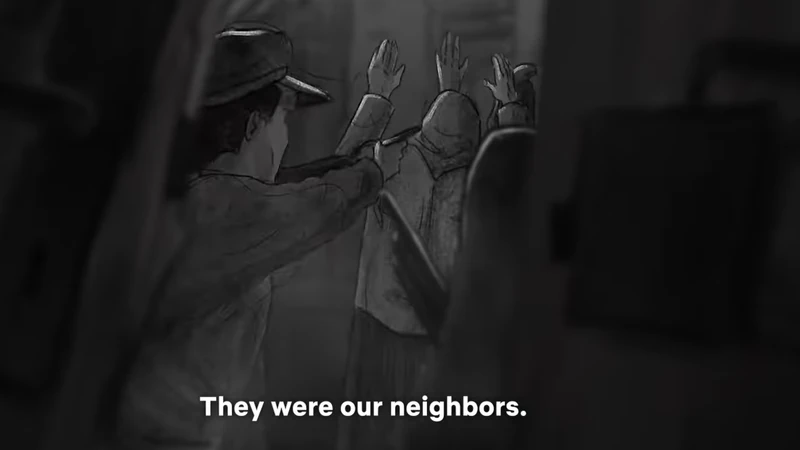
In a detailed report published on December 25, 2025, The Algemeiner describes the political backlash in Poland surrounding Among Neighbors, a documentary directed by Yoav Potash. The film focuses on the town of Gniewoszów, where Jews were murdered months after World War II ended—killed by local Polish Catholic neighbors after returning home from the Holocaust.
Potash insists the film is “not an anti-Polish film,” and says it contains stories that Poles can be proud of—alongside stories that should bring sober shame. That combination is exactly what makes the film hard for political extremists to tolerate: it refuses a national myth that says, “We were only heroes or victims. Nothing else.” (You can read Potash’s full comments in The Algemeiner’s article.)
But the heartbeat of the film is not politics. It’s testimony—especially the testimony of an eyewitness who spent decades carrying what she saw.
A “movie line” that lands like a witness stand:
“In a town where history has been silenced, an eyewitness to murder speaks out…”
— Among Neighbors (official film site)
That eyewitness is Pelagia Radecka. In reporting about the film, she is described as a local Polish woman who saw Jews murdered in Gniewoszów and lived under heavy pressure—first from perpetrators, later from political forces—to keep quiet. One account describes her on camera pointing out homes and saying: “That’s the house where the Weinbergs lived.” (This quote is relayed in coverage of the film.) See: The Jewish Standard’s article.
In other words: the film isn’t asking the world to argue about abstract guilt. It is asking the world to listen to a human voice—before time erases it.
Why would Catholic neighbors kill Jews after the Nazis were gone?
This question deserves a careful answer. The issue is not that Catholics are Jew Haters, nor that every Pole acted this way (many did not). Poland has thousands recognized as Righteous Among the Nations for risking their lives to save Jews. But in a predominantly Catholic society, some perpetrators were Catholic by culture and identity, while acting against the most basic demands of conscience and neighbor-love.
Historians point to a convergence of forces that fueled postwar anti-Jewish violence in Poland:
- Deep-rooted antisemitism, including blood-libel myths. The U.S. Holocaust Memorial Museum notes that the Kielce pogrom drew on entrenched antisemitism—especially false accusations that Jews used the blood of Christian children—and aimed to discourage Jewish survivors from returning. (See: USHMM timeline entry.)
- Fear, chaos, and social unraveling after war. Even after liberation, instability and violence remained widespread, and rumors could ignite mobs. (See also: USHMM Kielce encyclopedia article.)
- Property and restitution pressure. Returning survivors sometimes sought to reclaim homes, shops, and belongings. In towns where Jewish property had been seized or occupied, the survivor’s return could be treated as a threat—and greed can turn murderous. (For broader context on post-liberation violence patterns, see: Yad Vashem: Anti-Jewish Violence in Poland After Liberation.)
- Complicity and denial intertwined. The U.S. Holocaust Memorial Museum has documented that, as German forces implemented the killing, some Polish agencies and individuals were involved in denunciation, hunting Jews in hiding, blackmail, and plunder—realities that later became politically charged to acknowledge. (See: USHMM statement on Holocaust legislation in Poland.)
Naming these factors is not “anti-Polish.” It’s what moral adulthood looks like: telling the truth about what human beings are capable of—so we can refuse it in our own time.
Learning from the past—because the world is trying to repeat it
When a nation demands a spotless story, the first casualty is the witness.
One of the most sobering themes in Among Neighbors is not only what happened in Gniewoszów but what happened afterward: pressure to silence witnesses, and political punishment for telling a complicated truth. That is why Potash’s film is being attacked in Poland by officials and commentators who call it “anti-Polish historical manipulation,” as noted in multiple reports. (See: The Algemeiner and The Jewish Standard.)
Christian women understand something the world keeps forgetting: truth is not optional. When we sanitize history, we don’t heal it—we fertilize the ground for a return of the same sins in new clothing. Antisemitism has always depended on selective memory: forgetting Jewish suffering, minimizing Jewish fear, rewriting Jewish testimony, and punishing those who insist on telling the full story.
“The Lord detests lying lips, but he delights in people who are trustworthy.” (Proverbs 12:22, NIV)
Among Neighbors is ultimately asking: will we protect the witness, or will we protect the myth? That question doesn’t belong only to Poland. It belongs to every society where the truth about Jews becomes “inconvenient,” “too complicated,” or “too costly.”
If you’d like to learn more about the film, you can start here: official site. (The site includes background, screening info, and press coverage.)
Sources (linked)
- The Algemeiner (Dec. 25, 2025): “Poles Watching Can Be Proud…”
https://www.algemeiner.com/2025/12/25/poles-watching-can-be-proud-director-defends-holocaust-film-10-years-in-the-making-sparking-backlash-in-poland/ - Among Neighbors (official film site): About the film
https://www.amongneighbors.com/about - The Jewish Standard (Oct. 9, 2025): “The dark secret of ‘Among Neighbors’”
https://jewishstandard.timesofisrael.com/the-dark-secret-of-among-neighbors/ - USHMM (timeline): Kielce pogrom
https://encyclopedia.ushmm.org/content/en/timeline-event/holocaust/after-1945/kielce-pogrom - USHMM (encyclopedia): The Kielce pogrom article
https://encyclopedia.ushmm.org/content/en/article/the-kielce-pogrom-a-blood-libel-massacre-of-holocaust-survivors - USHMM statement (2018): Holocaust legislation in Poland
https://www.ushmm.org/information/press/press-releases/museum-statement-on-holocaust-legislation-in-poland - Yad Vashem: Anti-Jewish Violence in Poland After Liberation
https://www.yadvashem.org/articles/general/anti-jewish-violence-in-poland-after-liberation.html
Today’s Prayer:
Lord, make us women who love truth more than comfort. Strengthen the witnesses who speak when others demand silence. Heal what hatred has shattered between neighbors. Guard the Jewish people, and teach us to stand with them with courage, clarity, and steady love. In Jesus’ name, amen.


