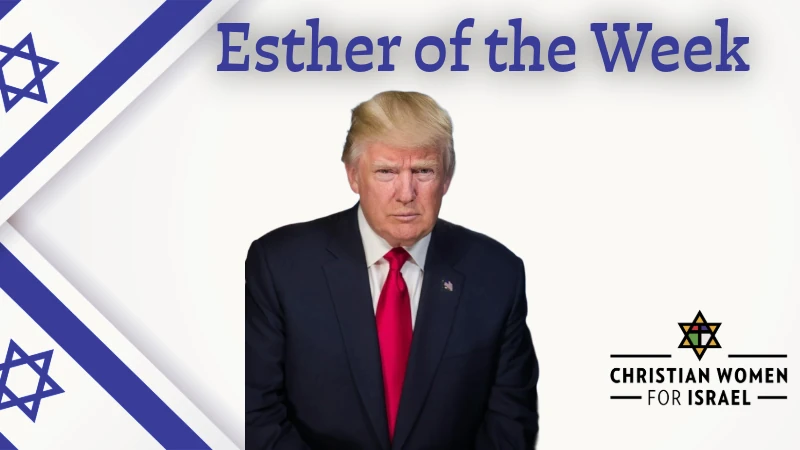
Esther is not the only figure in her story.
There is also Mordecai.
He is the one who refused to bow. The one who named the threat before others were willing to see it. The one who stood publicly against hatred, even when it was dangerous or unpopular to do so.
This week’s Esther of the Week is, in truth, a Mordecai moment.
When President Donald Trump spoke plainly about antisemites, saying, “We don’t like them. We don’t need them,” he did something that has been increasingly rare. He named the danger without qualification. He did not excuse it. He did not minimize it. He did not hide behind political convenience.
That matters.
Mordecai did not speak softly about Haman. He did not call him misunderstood. He did not suggest patience or tolerance in the face of evil. Scripture tells us he identified the threat clearly and refused to participate in it. His courage created the conditions that allowed Esther to act.
Words spoken at the right moment can restrain evil.
President Trump’s record on behalf of the Jewish people reflects that same willingness to act when it counted. As president, he recognized Jerusalem as Israel’s capital and moved the U.S. embassy there, ending decades of diplomatic equivocation. He recognized Israel’s sovereignty over the Golan Heights. He helped broker the Abraham Accords, reshaping relationships in the Middle East through strength rather than appeasement. He confronted Iran’s nuclear ambitions instead of treating them as something to manage indefinitely.
More recently, his leadership has been tied to outcomes many once said were impossible. Hostages have come home. Hamas, long treated as an immovable reality, is being dismantled before the world’s eyes. What was once tolerated, excused, or delayed is now being addressed directly, with clarity about who the enemy is and what is required to stop it.
These were not symbolic gestures. They were decisions made with consequences.
For President Trump, this stance is not only political. It is personal. He has spoken openly as a father and grandfather whose daughter and grandchildren are Jewish. Standing against antisemitism is about protecting real children, real families, and a future that must not be surrendered to hatred.
This week, we reflected on that clarity in our article Trump Draws a Line: A Moment of Moral Clarity for the Right. That reflection examined why naming antisemitism matters, especially when it appears close to home. The same principle applies here.
Mordecai moments do not always look dramatic. Sometimes they are moments of clarity, when a leader says what others are afraid to say and draws a line that needed to be drawn.
At Christian Women For Israel, we recognize the importance of those moments. Standing with the Jewish people requires more than sentiment. It requires discernment, courage, and the willingness to confront evil before it gains ground.
Mordecai understood that antisemitism does not announce itself all at once. It grows when it is tolerated. It strengthens when it is rationalized. It becomes lethal when leaders refuse to name it.
Scripture records Mordecai’s refusal to remain silent, and Esther’s willingness to act followed. The story reminds us that deliverance often begins when someone speaks first.
“For if you remain silent at this time, relief and deliverance for the Jews will arise from another place.”
Esther 4:14
This week’s Esther of the Week reminds us that sometimes faithfulness looks like refusing to bow, refusing to excuse hatred, and refusing to stay quiet when Jewish lives are at stake.
Today’s Prayer
Lord, thank You for moments of moral clarity. Thank You for leaders who are willing to name evil and stand against it. Strengthen those who protect the Jewish people through courage and truth. Give us wisdom to recognize Mordecai moments when they arise, and the resolve to respond faithfully. Amen.
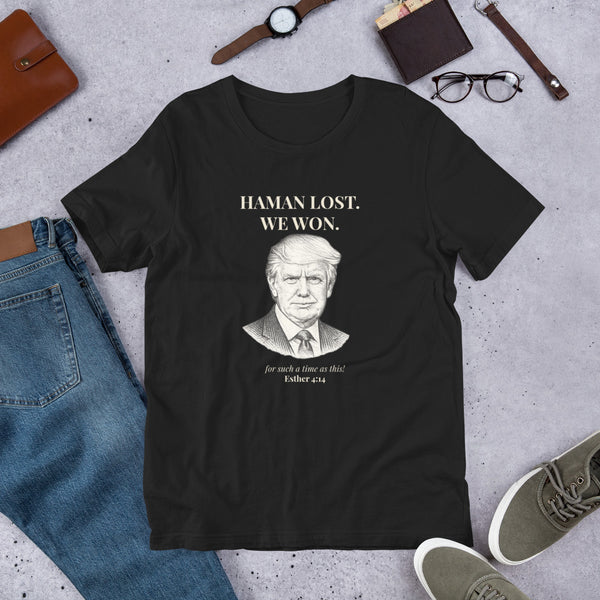
This tee is part of our limited Haman Lost. We Won. collection—created for this moment, rooted in the story of Esther, and designed to be worn with quiet conviction.