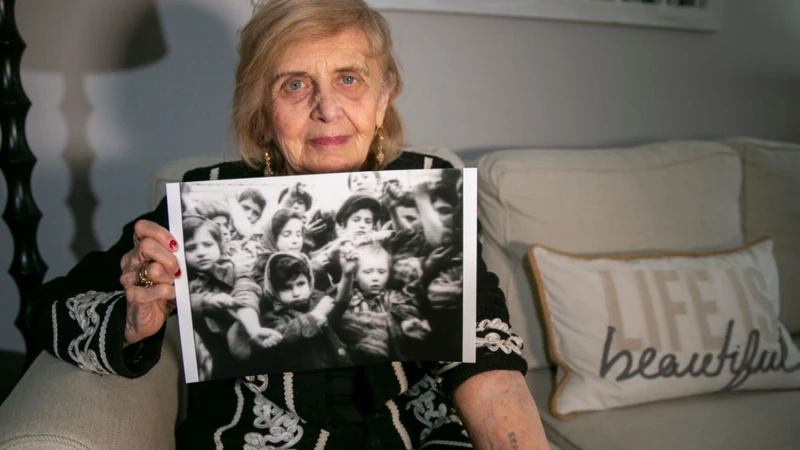
A Child Who Lived, a Grandmother Who Remembers
Esther was not a warrior. She did not command armies or argue cases in court. She carried memory. She stood when others were erased. And when the moment came, she spoke.
This week’s Esther of the Week is Tova Friedman, one of the youngest known survivors of Auschwitz and one of the last living child witnesses to the Holocaust.
Tova was born in 1938, just one year before Nazi Germany invaded Poland. She was four years old when her childhood ended. Five when she learned how to stand still so she would not be shot. Six when she was tattooed with a number instead of called by her name.
She survived Auschwitz not because she was stronger or braver, but because her parents were relentless in their will to keep her alive. They taught her how to hide, when to be silent, where to stand, and how not to draw attention. Her survival was the result of strategy, sacrifice, and a mother who refused to surrender her child to death.
“Education without morality is completely worthless,” Tova has said, reflecting on the calculated cruelty of the Nazi regime.
“These were brilliant people. Doctors. Lawyers. Engineers. And they used their intelligence to destroy us.”
Tova remembers living under tables in overcrowded apartments. She remembers grandparents taken downstairs and shot. She remembers her parents digging graves for their own families. She remembers learning, as a small child, that noise meant danger and that questions could get you killed.
And yet, she lived.
When Auschwitz was liberated in January 1945, only 57 children under the age of eight were found alive. Tova was one of them.
She carried that reality into adulthood.
For decades, she did not speak publicly. Like many survivors, she focused on building a life. She became a therapist. She raised children. She built a family. But memory does not disappear simply because it is silent.
Eventually, Tova understood what Esther understood. Silence can become its own form of danger.
Today, Tova Friedman speaks to thousands of students each year. She stands before classrooms and tells them what happened when hatred was allowed to grow unchecked. She speaks not in abstractions, but in details. Shoes. Bread. Numbers. Names. The slow dismantling of family, faith, and humanity.
“If we forget them, then Hitler wins,” she has said.
“I speak so that my family does not die a second time.”
Tova does not speak to accuse. She speaks to warn.
She tells young people that genocide does not begin with camps. It begins with language. With lies. With the dehumanization of one group of people until their suffering is dismissed, then justified, then celebrated.
She has said plainly that what frightens her most today is not that people deny the Holocaust outright, but that they no longer recognize the signs that led to it.
In a time when antisemitism is again rising openly on college campuses, in public discourse, and across social media, Tova’s voice carries a weight that no ideology can dismiss. She is not speaking about history. She is speaking about memory lived.
Esther once said, “If I perish, I perish.”
Tova lived. And because she lived, she now carries a responsibility that few can bear.
She reminds us that survival alone is not the end of the story. What matters is what we do with the life that was spared.
This week, we honor Tova Friedman as our Esther of the Week. Not because she chose this role, but because history chose her. And because she has chosen, again and again, to speak when silence would be easier.
Her courage is not loud. It is steady.
Her strength is not performative. It is faithful.
And her message is clear.
Memory is a responsibility.
Truth must be spoken.
And the next generation must be taught to recognize evil before it is too late.


