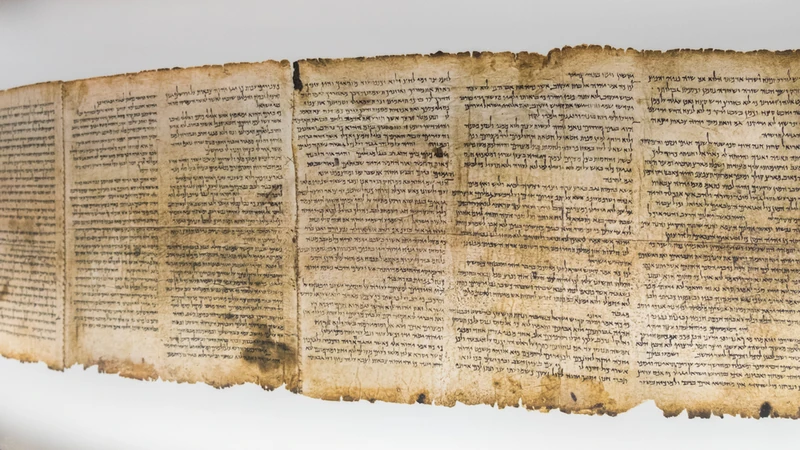
In 1947, a Bedouin shepherd tossed a stone into a cave on the northwest shore of the Dead Sea and heard pottery break. Inside, he and his companions found clay jars filled with ancient scrolls.
Those scrolls—the Dead Sea Scrolls—turned out to be some of the oldest biblical manuscripts ever discovered. Among them was something stunning:
A nearly complete scroll of Isaiah, copied about 100–150 years before Jesus was born.
So when you and I open our Bibles at Christmas and read:
“For to us a child is born,
to us a son is given,
and the government will be on his shoulders.
And he will be called Wonderful Counselor, Mighty God,
Everlasting Father, Prince of Peace.”
— Isaiah 9:6 (NIV)
…we are not reading a prophecy edited after the fact to “fit” Jesus.
We are reading words that were already cherished, copied, and prayed over in Jewish communities long before Mary ever held her baby in Bethlehem.
The scroll in that cave was like God saying to the modern world:
“Yes, My promises were there all along.”
A Jewish Book, a Jewish Baby, a Jewish Promise
The Dead Sea Isaiah scroll doesn’t just prove how old the text is. It quietly reminds us who it belongs to.
Isaiah is a Jewish prophet, speaking to a Jewish people, about a Jewish Messiah who will bless all nations.
The same scroll that says:
“For to us a child is born…” (Isaiah 9:6)
also says:
“Comfort, comfort my people, says your God.
Speak tenderly to Jerusalem…”
— Isaiah 40:1–2 (NIV)
and:
“He was pierced for our transgressions,
he was crushed for our iniquities…”
— Isaiah 53:5 (NIV)
All of that was already on the page, in ink, in that cave by the Dead Sea.
So when we celebrate Christmas, we are not stepping out of Israel’s story—we are stepping into it:
The baby in the manger is Israel’s promised King.
The cross on Calvary is Israel’s promised suffering servant.
The empty tomb in Jerusalem is Israel’s promised hope for the nations.
As Christian Women For Israel, we’re not forcing a connection between Christmas and the Jewish people—we’re honoring the one God Himself placed in Scripture and preserved in the caves by the Dead Sea.
God Preserved the Scrolls. What Does That Say About Him?
The Dead Sea region is one of the harshest places on earth: dry, hot, and barren. Yet that climate helped preserve fragile parchment and leather for two thousand years.
Why were those scrolls still there?
Scholars can give us scientific answers about humidity and salt and caves. But for a modern-day Esther, there is also a spiritual answer:
God is a keeper of promises.
He preserved His word through exile, empire, fire, and war—so that in an age of doubt, we would have physical evidence that Isaiah’s prophecies were not invented after Jesus.
When critics say, “Those messianic prophecies were written later,”
the scroll quietly replies, “No—they were already here.”When our own hearts whisper, “Can I trust God’s promises?”
the jars under that tree in the desert answer, “He keeps what He says.”
“The grass withers and the flowers fall,
but the word of our God endures forever.”
— Isaiah 40:8 (NIV)
The same God who kept Isaiah’s words safe in stone caves keeps watch over His people Israel, over His promises, and over you.Christmas at the Foot of the Scroll
This year, as you hear familiar Christmas verses, imagine them not only on a greeting card—but on ancient parchment, written by a Jewish scribe who had never heard the name “Jesus” and yet copied these words with fear and trembling:
“The people walking in darkness have seen a great light;
on those living in the land of deep darkness a light has dawned.”
— Isaiah 9:2 (NIV)
Centuries later, shepherds in that same land of darkness saw angels over Bethlehem. Wise men followed a star. A young Jewish mother cradled the Light of the World in her arms.
And now, two thousand years after that, you and I hold Isaiah in our hands—with Dead Sea evidence that God’s promises were already in motion long before anyone saw the manger.
Christmas is not a “new” story. It is the continuation of a very old one.
A Call to Esthers at Christmas
So what does all this mean for us, Christian Women For Israel?
It means:
When you hear Isaiah read in church, you can silently thank God for those scrolls in the desert—and for the Jewish scribes who preserved them.
When you decorate your home, you can remember that the Child you celebrate is the Jewish Messiah, promised to Israel for the sake of the world.
When you pray for peace in Jerusalem and safety for the Jewish people, you are praying in line with the same God who said through Isaiah, “Comfort, comfort my people.”
As a modern-day Esther, you are a kind of keeper of memory:
You remember that the Bible is a Jewish book.
You remember that your Savior is a Jewish King.
You remember that the promises of Christmas are rooted in the promises to Abraham, Isaac, and Jacob.
In a world that forgets—or twists—Israel’s story, you stand as a watchman on the walls, saying:
“These words are real. These promises are old. And this God is faithful.”
Today’s Prayer
Lord Jesus,
Thank You that long before Bethlehem, You had already spoken through Isaiah. Thank You for preserving Your word in the caves by the Dead Sea, and for the Jewish people who guarded these Scriptures through the centuries.
This Christmas, help me remember that You are Israel’s promised Messiah and the world’s only Savior. Make me a modern-day Esther—a woman who loves Your Word, blesses Your people Israel, and trusts Your promises even when the world is full of doubt.
In Your name I pray, Amen.

Stand with Israel as a Modern-Day Esther
When you give to Christian Women For Israel, you help comfort God’s people, push back rising antisemitism, and raise up modern-day Esthers who pray, teach, and act “for such a time as this.”
Your generosity today strengthens this work in Israel and around the world.
Stand with Israel – Donate Now

