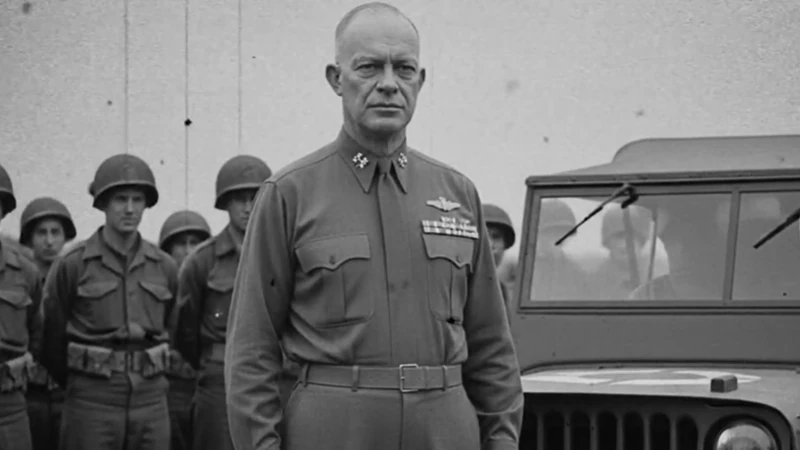
There are moments when a leader does more than win a war. He protects the truth.
In April 1945, General Dwight D. Eisenhower did exactly that.
American forces had liberated Ohrdruf, a Nazi camp connected to the Buchenwald system. Eisenhower did not treat what was discovered there as something to be summarized and filed away. He insisted on seeing it with his own eyes. On April 12, 1945, Eisenhower visited Ohrdruf alongside Generals Omar Bradley and George S. Patton.
He went because he understood something that still feels painfully modern: when the truth is unbearable, people look for ways to shrink it. To soften it. To explain it away. To call it exaggerated. To call it staged. To call it propaganda.
Eisenhower was determined to make that impossible.
“The things I saw beggar description.”
A few days later, Eisenhower wrote to Army Chief of Staff General George C. Marshall about what he had seen. His words were not polished. They were blunt and human. He described evidence of “starvation, cruelty and bestiality” so overwhelming it left him physically ill.
“The visual evidence and the verbal testimony … were so overpowering as to leave me a bit sick.”
Then he wrote the line that explains the entire reason he went.
“I made the visit deliberately … if ever … there develops a tendency to charge these allegations merely to ‘propaganda.’”
That sentence is the backbone of the story. Eisenhower was not only looking at the horror in front of him. He was looking forward, to the future argument he knew would come. He understood that denial is not an accident. It is a reflex. A way to escape the weight of what is too awful to accept.
So he treated truth like something that had to be guarded.
Why witness mattered more than reports
Eisenhower could have accepted briefings. He could have delegated. He could have read the paperwork and moved on.
He did not.
He wanted a record that would survive cynicism. He wanted proof that would outlast politics. He wanted evidence so solid that a lie could not wedge itself into the story later.
That is why he pushed for more than military testimony. He wanted journalists to see it. He wanted lawmakers to see it. He wanted the wider world to see it. He understood that the truth is harder to dismiss when many credible witnesses can say the same thing.
And he wanted nearby German civilians brought to see what had been done. Not to shame them for sport, but to remove the refuge of pretending. A society cannot heal if it insists on looking away.
He did not visit Auschwitz, and that detail matters
People sometimes ask whether Eisenhower visited Auschwitz.
He did not. Auschwitz was liberated by Soviet forces in January 1945, and Eisenhower’s command was on the western front. But the point is not which gate he stood at. The point is the standard he modeled when confronted with mass atrocity:
Go. See. Document. Bring witnesses. Preserve evidence. Refuse to let time and comfort rewrite the truth.
The lesson for our time
Eisenhower understood that after the killing stops, another battle begins: the battle over memory.
If evidence is not preserved, stories become malleable. If witnesses are not elevated, denial gains room. If leaders look away, the lie gets a head start.
Eisenhower did not look away.
He wanted the truth recorded with such authority that future generations could not claim ignorance and could not dismiss the horror as rumor.
In an age where people argue with history like it is optional, his approach still speaks with force.
Not because it is dramatic. Because it is disciplined.
Because it is moral.
Because it is protective.
He left the world with something denial cannot defeat:
I was there.
I saw it.


