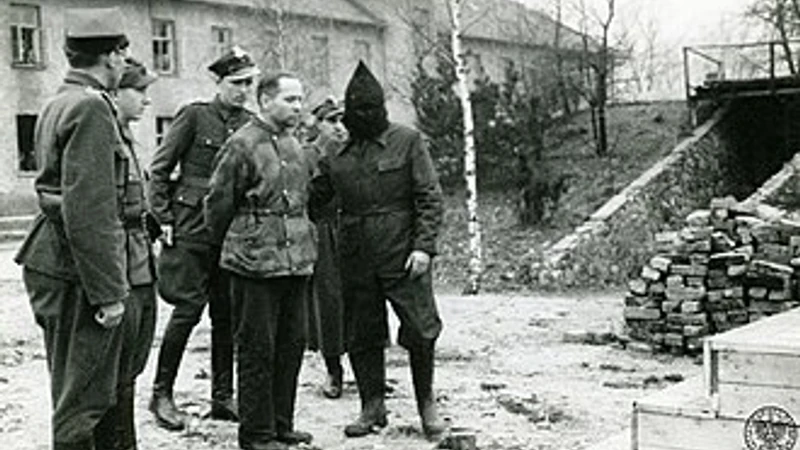
On a cold morning in April 1947, Rudolf Höss walked through Auschwitz one last time.
His hands were cuffed behind his back. Guards helped him climb a small stool beneath a trapdoor. A priest stood nearby. The noose was placed over his head. Höss adjusted it with a small movement, as if tidying a collar.
Then the stool was pulled away.
He dropped. The trapdoor opened. His lifeless body swung in the courtyard next to the crematorium.
The man who helped perfect Auschwitz’s killing process died within sight of the machinery he once ran.
But Auschwitz was never only a place. It was a method.
And methods have a way of surviving.
The man who made death efficient
Höss did not invent hatred. He organized it.
When he was appointed commandant, Auschwitz began as a prison camp built around old military barracks. Under his leadership it expanded, grew teeth, and learned how to kill with scale. Trains arrived. Lines formed. Orders were barked. Clipboards moved. Human beings were sorted.
Auschwitz became a system that could be refined.
Höss studied other camps, watched what was working, and looked for improvements. He learned that terror slows the line. Panic makes people resist. Resistance creates disorder.
So he leaned into something calmer.
He leaned into procedure.
And one of his most chilling “procedures” was a word.
Shower.
At Auschwitz, victims were often told they were going to be disinfected, deloused, cleaned. They were ordered to undress. To hang clothing neatly. To remember a hook number. Some were told they would get the clothes back. Some were told it would be quick.
A room built to resemble cleansing became a room built for killing.
The door shut. The air turned poisonous. People clawed, choked, collapsed.
A shower, as a promise, became a lie that kept the line moving.
By the end, more than 1.1 million people died at Auschwitz, including approximately one million Jews. That is not a statistic. That is a million families cut off at the root.
And Höss was a central engineer of the system that made it possible.
A ring that told the truth
After the war, Höss did what many cowards do.
He ran.
He disguised himself, used a false name, and tried to blend into ordinary life. When British troops finally found him, he denied who he was. He insisted he was someone else.
Then a soldier demanded his wedding ring.
Höss resisted. He claimed it was stuck. The soldier pressed harder, even threatening to cut his finger off.
When the ring finally came free, the lie came with it.
Inside the band were two names engraved into the gold: Rudolf and Hedwig.
The most efficient liar can still be undone by one stubborn detail.
Höss was arrested, tried, sentenced, and returned to Auschwitz for execution. He died near the crematorium because history wanted the location to speak.
Justice, as far as human courts can offer it, came to the architect of a killing process.
But the deeper warning did not die on that rope.
The chemical, the corporation, and the trail that continues
Auschwitz did not operate on hatred alone. It operated on supply.
It required rail schedules, construction, guards, paperwork, procurement, and chemicals. It required products that existed in the commercial world and were redirected into death.
Zyklon B was originally a pesticide. In Auschwitz it became a tool of human extermination.
And behind that chemical were corporate structures and investments, the industrial world’s quiet ability to keep doing business while claiming it was simply doing business.
After the war, the corporate map did not vanish. It rearranged.
Names changed. Companies were broken apart. Successor corporations emerged. Ownership shifted. The world moved forward, but the corporate bloodstream kept flowing.
That matters because it shows something most people do not want to admit:
Institutions can outlive the crimes they once enabled.
They can rebrand, reorganize, and continue, even while history carries their fingerprints.
If you “follow the trail,” you can see how the industrial world that once profited in the orbit of mass death continued to exist in new forms, under new names, in new markets.
The paperwork changed. The business of death did not.
In the Nazi era, Zyklon B was distributed by a company connected to the industrial giant IG Farben. After the war, IG Farben was broken apart, and its successor companies became major industrial and pharmaceutical powerhouses. One of those successor lines led, decades later, into the corporate parentage connected to the company that developed RU-486, also known as mifepristone.
What mifepristone is, and how many lives it has ended
Mifepristone, often called RU-486, is commonly known as the abortion pill. It is the first drug in a two-drug medication abortion regimen. It works by blocking progesterone, a hormone needed to sustain pregnancy, and is typically followed by misoprostol to complete the abortion.
And now the number that forces a modern comparison most people do not want to look at:
In the United States, the estimate of mifepristone use to terminate pregnancy through the end of December 2024 is approximately 7.5 million.
That is roughly seven times the number of human beings who died at Auschwitz.
Let that sit for a moment.
You do not need to claim the events are identical. They are not. Auschwitz was genocide. Medication abortion is framed as healthcare. The historical contexts differ.
But the comparison exposes something else, something moral and cultural:
How quickly death becomes normal when it is framed as private, clinical, and managed.
How quickly language can soften reality until the human being disappears.
The modern shower
Now imagine a scene that does not look like a camp at all.
A bathroom at home. Steam on the mirror. A phone on the counter with instructions. A towel folded. Water running.
No uniforms. No guard towers. No barking orders. Just a closed door and ordinary tile.
The shower becomes a place to hide trembling hands. To muffle sobs. To keep the moment private. To rinse away blood.
It is clean. It is domestic. It is quiet.
And in that quiet, an innocent life ends. A life with no voice. No vote. No ability to plead for mercy.
At Auschwitz, “shower” was used to fool victims into walking into death.
In modern America, the shower can become the place where death is made private, sanitized, and unseen.
Different room. Different century. Different mechanism.
But the same old tactic.
Make it feel like procedure.
Make it feel like cleansing.
Make it feel like nothing.
The Holocaust is not only history. It is a warning.
The Holocaust did not only reveal what monsters do.
It revealed what ordinary systems will support when conscience goes quiet and language becomes slippery. It revealed how fast a culture can be trained to accept death as a solution, especially when death is dressed in clean words.
Höss died beside a crematorium.
But the evil that lurked in Auschwitz was never only in brick and barbed wire.
It was in the lie that made killing efficient.
It was in the ability to turn human beings into a problem to be processed.
It was in the supply chains and corporate structures that survived the war, changed clothes, and kept going.
That is why the horrors of the Holocaust still plague society.
Not because we still live in 1944.
But because the same moral shadow still knows how to move.
It does not always arrive shouting.
Sometimes it arrives whispering.
Sometimes it arrives with instructions on a screen.
Sometimes it arrives behind a closed bathroom door, under the sound of running water.


