Some gatherings are just a program, a meal, a few speeches, and you move on.
Other gatherings land in a deeper place. The room feels weightier. People are more present. What’s said stays with you. You leave changed, not just informed.
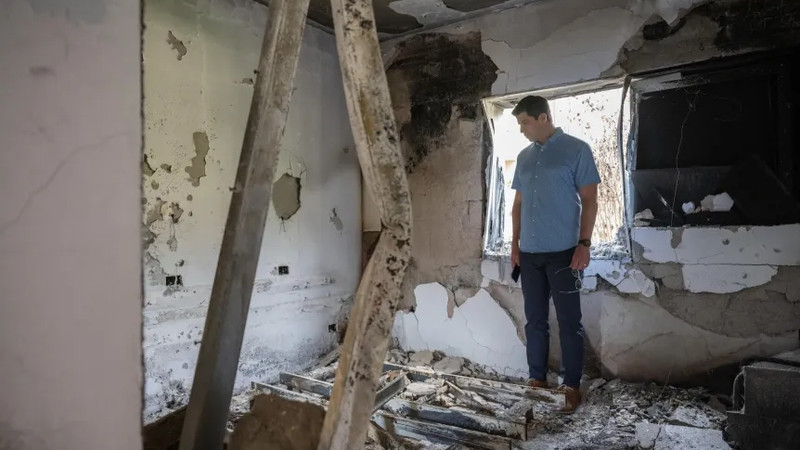
The Jewish National Fund breakfast I attended this week was a sobering reminder that standing with Israel is more than a slogan. When Judge Roy Altman spoke about October 7, the room was moved to tears.
Judge Altman is a U.S. District Judge for the Southern District of Florida, and he has been traveling the country speaking about Israel and the way public debate has been distorted. In one of his talks, he says many arguments about Israel are built on “a mythology, a narrative that’s untrue,” along with accusations that are “questions of law.” His forthcoming book Israel on Trial: Examining the History, the Evidence, and the Law. (Pre-order your copy today) is meant to meet those claims with history, evidence, and legal clarity.
But at this breakfast, what broke through first was not law. It was loss.
The field that made the room weep
Judge Altman described the Nova Festival memorial area, a wide open stretch of land now covered with hundreds of mounds of dirt. Each mound marks where someone died. Many are paired with a photo and a name. Not as a “map,” but as a field of grief, row after row after row.
As he spoke, you could feel the room trying to take it in. It is one thing to hear “hundreds were killed.” It is another thing to picture a field where the earth itself has been lifted into mounds to mark where bodies fell.
Then he described a scene that brought tears without effort.
A mother was laying on top of one of those mounds of dirt. Inconsolable. Her family could not pull her away. There was no comforting phrase that could reach her. No gentle explanation. Just a mother clinging to the place where her child’s life ended.
You could hear quiet crying across the room. People looking down at their plates, blinking fast, trying to hold themselves together, because every parent in that room understood her pain.
The question no one should ever have to ask
Judge Altman then shared a moment from the first response, when a soldier arrived at the scene and cried out in Hebrew:
האם מישהו חי?
Ha’im mishehu chai?
“Is anyone alive?”
It was October 7, 2023, a Saturday. And on that day, the unthinkable unfolded. In the aftermath, a soldier arrived and cried out the words no one should ever have to say in modern life:
“Is anyone alive?”
Not, “Where are you?”
Not, “Are you hurt?”
Not, “Help is coming.”
Alive.
That is what evil does. It forces the world to confront a kind of brutality we associate with the darkest chapters of history. It forces words into the air that should not exist today, and it leaves survivors carrying images they will never unsee.
“Hatikvah” and the resilience of a people
And then, Judge Altman said, he heard something unexpected.
As he looked out over those mounds of dirt, with that mother still crying and refusing to be moved, he heard the faintest sound in the distance. Women together, singing.
“Hatikvah.”
The Hope.
Not loud. Not polished. Not staged.
Hope, barely above a whisper, but still alive.
In that moment, Judge Altman understood something deep about the resilience of his people. Terror does not only aim to kill. It aims to break the spirit. And yet there, over a field of fresh grief, the Jewish spirit refused to be extinguished.
What it means to be an October 8 Jew
Judge Altman also spoke about what came next, what he called the shock of October 8. The day after the massacre, when many Jewish people realized how fast the world could twist the story, how quickly empathy could be replaced by excuses, and how openly hatred could surface.
Being an “October 8 Jew” is living with that clarity.
It is waking up to the realization that truth is not automatically protected, even when the evidence is overwhelming. That denial does not wait decades. It starts immediately. That some people will look straight at Jewish suffering and explain it away.
It is also realizing who your friends are.
A flare went up, and you could see who was with you and who was not.
Eisenhower and the duty to bear witness
Listening to Judge Altman, I kept thinking about another moment in history when a leader understood that truth must be documented, not assumed.
In April 1945, General Dwight Eisenhower visited the Ohrdruf concentration camp and insisted on seeing it firsthand. When officers offered reports and photographs, his answer was simple: “I want to see everything.” He demanded witnesses, cameras, and public record because he believed “history will try to deny this.” Later, he would be able to say, “Because I was there, I saw it.”
That same refusal to look away is what our generation needs now. And that is why Judge Altman takes federal judges, and now state judges, to Israel, so they can bear witness for themselves. He believes truth is harder to dismiss when leaders have seen the land, met the people, and stood in the places where history is still unfolding.
Read that Eisenhower account here.
A closing word I cannot shake
I left the JNF breakfast grateful, sobered, and more determined to show up again.
Standing with Israel is telling the truth when lies spread fast. It is refusing to look away when the images are hard. It is staying close to the Jewish people when the cost rises.
And it is remembering that sometimes the most powerful thing a person can do is keep hope alive, even when their eyes are full of tears.


